Subterranean termite soil treatment establishes a continuous subterranean barrier around slab-on-grade homes, stem walls, and structural crawl spaces. In Riverside, summer temperatures exceeding 100 degrees Fahrenheit…
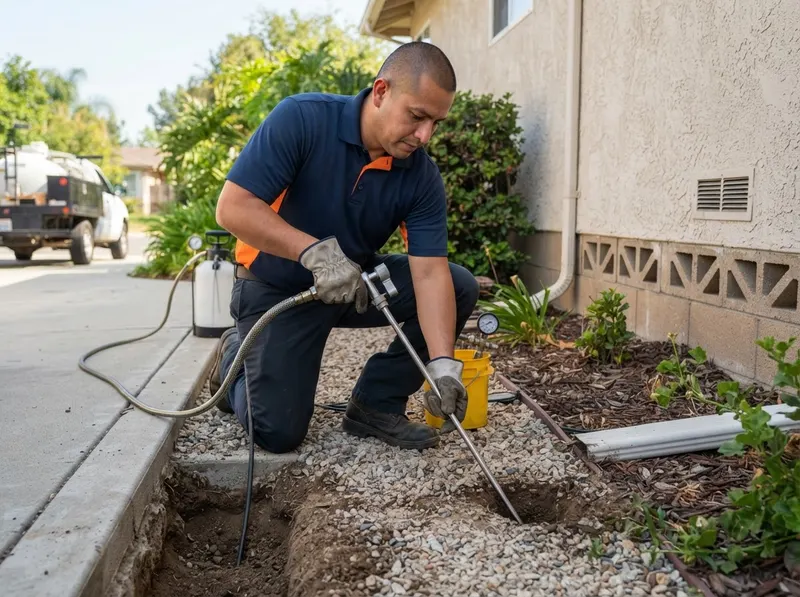
Subterranean termite soil treatment establishes a continuous subterranean barrier around slab-on-grade homes, stem walls, and structural crawl spaces. In Riverside, summer temperatures exceeding 100 degrees Fahrenheit drive subterranean termites deep underground seeking residual hydration, frequently directly under irrigated foundations in neighborhoods like Canyon Crest, Victoria, and Orangecrest. Non-repellent active ingredients such as fipronil bind directly to clay-heavy Inland Empire soil matrices via trenching and pressurized chemical injection. Because workers do not detect the chemistry, social grooming and trophallaxis pass the lethal dose directly back through the colony network, eliminating subterranean termites before subterranean tunnels breach structural timber framing. A soil liquid perimeter suits homes with slab foundations or subterranean colonies nesting within exterior garden beds; for elevated drywood colonies infesting attic ridge-beams without ground contact, structural localized wood injection or structural fumigation serves as the correct alternative mechanism. The trade-off requires localized concrete drilling through attached garage slabs or patio expansions to ensure the liquid barrier remains unbroken.
Installing this barrier follows an exact mechanical sequence verified against strict environmental and construction parameters. First, technicians excavate a trench measuring 6 inches wide by 6 inches deep immediately adjacent to the structural foundation wall. Second, pressurized rodding delivers 4 gallons of mixed dilution per 10 linear feet into the trench bottom, saturating downward to the structural footing depth as outlined by EPA guidelines for pesticide use. Third, attached concrete slabs, such as driveways, front walkways, and garage perimeters commonly found in Hawarden Hills and Wood Streets, undergo diamond-core drilling at 12-inch intervals within 6 inches of the foundation stem. Fourth, sub-slab injection delivers termiticide directly beneath the slab before every bore hole is sealed flush with matching structural hydraulic cement, aligning with standards recognized by the National Pest Management Association.
Riverside soil variations dictate precise volume calculation. Older historic homes in Downtown and Wood Streets built with raised-foundation cripple walls require interior crawlspace trenching alongside exterior perimeters, maintaining strict clearance distances from domestic water wells and open runoff basins as mandated by the Santa Ana Regional Water Quality Control Board. In modern tract home developments across Mission Grove and Arlington Heights, heavy clay soil limits absorption speed, requiring slower, low-pressure sub-surface rodding to prevent chemical surface ponding. These liquid barrier applications comply directly with California structural pest regulations maintained by the California Structural Pest Control Board, while preventing chemical runoff into sensitive riparian habitats protected under the California Department of Fish and Wildlife. Properties positioned near agricultural groves or citrus plantings in Arlington Heights and around the California Citrus State Historic Park must utilize strict non-leaching compounds registered under the California Department of Pesticide Regulation, preventing any unintended drift into surrounding agricultural soil systems governed by the California Department of Food and Agriculture.
Protective protocols prioritize environmental safety around domestic spaces. Once soil and sub-slab applications bind to the substrate, non-repellent termiticides become insoluble and will not volatilize into interior household airspace or leach into adjacent turfgrass lawns. Children and household pets can re-enter treated exterior yard zones as soon as the backfilled soil dries thoroughly, which takes 2 to 4 hours in warm Inland Empire climates. Structural perimeter soil treatment prevents subterranean pests from chewing through sill plates, floor joists, or electrical conduit paths outlined in safety frameworks from the Occupational Safety and Health Administration. Routine perimeter preservation aligns with housing maintenance principles set by the U.S. Department of Housing and Urban Development and wildland-urban interface protection standards supported by the U.S. Forest Service. For direct technical questions, call Nationwide Pest Defense at (951) 709-8193.
Every job gets a firm, written price after a free on-site visit.
For standards, safe disposal, and service guidance on pest control services in Riverside, CA, useful references include U.S. EPA, ENERGY STAR, U.S. Dept. of Energy, Consumer.gov, U.S. Census Bureau, and Google Maps. General consumer and small-business resources are available from USA.gov, Better Business Bureau, FTC Consumer Advice, U.S. Small Business Administration, and Ready.gov.
Tell us about your subterranean termite soil treatment job in Riverside and we'll send a clear, written quote, usually the same day.
 Nationwide Pest Defense